

Israel's Dolphin-Class Submarine Changes the Iran War
Israel is positioning their nuclear-armed submarines near Iranian targets. Is it deterrence or a first strike?

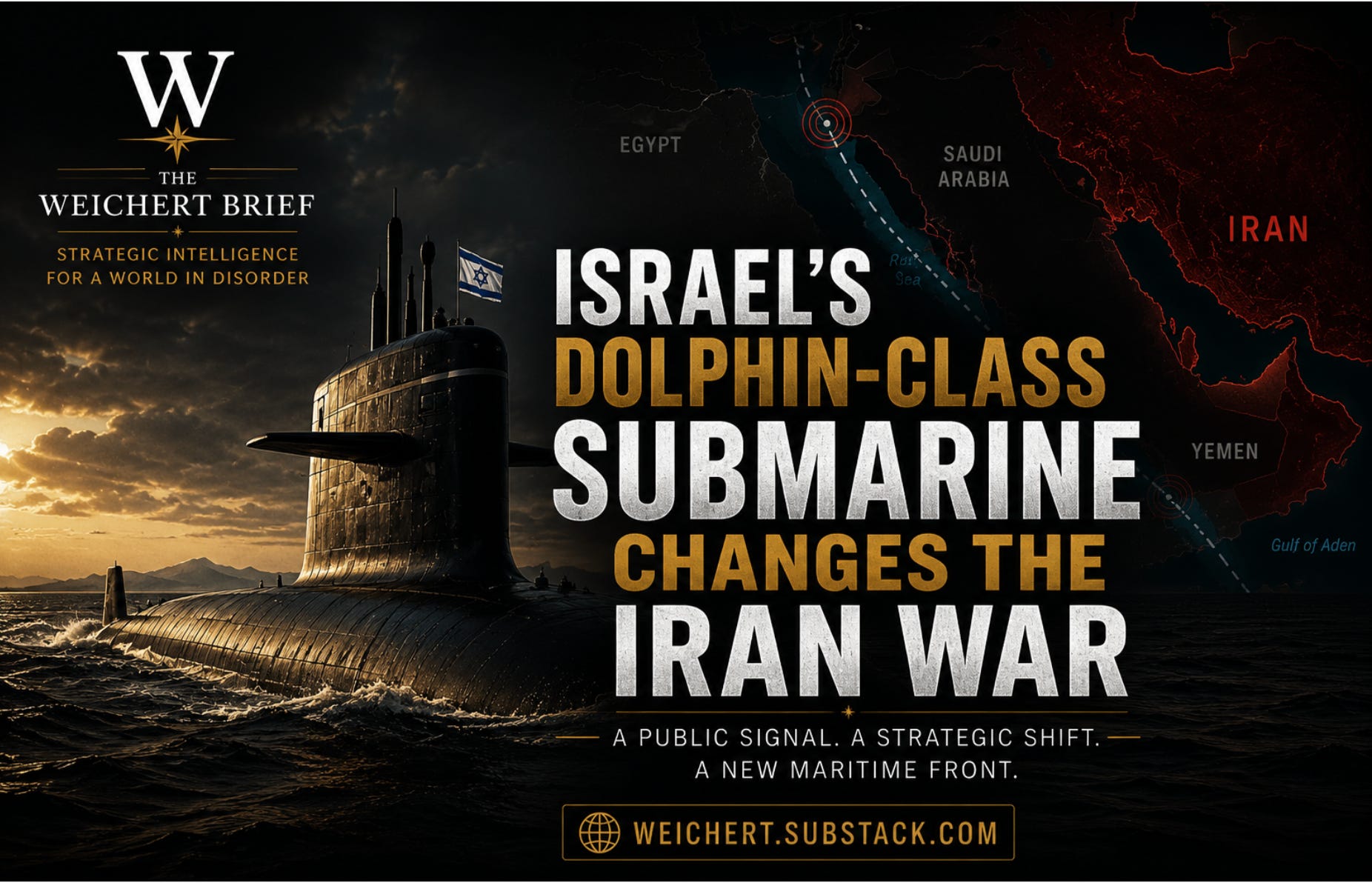
BLUF: Israel’s unusually public deployment of a Dolphin-class submarine suggests Jerusalem believes the next phase of the Iran War will be decided less by airstrikes over Iran than by control of the Red Sea and the Strait of Hormuz. By signaling its undersea deterrent, Israel is warning Iran, the Houthis, and even Washington that maritime dominance is becoming the conflict’s decisive front.
The Iran War has taken seriously unwanted turns, as the United States and Israel constantly escalate against the Islamic Republic of Iran—and the Iranians, much to the surprise of Tel Aviv and Washington, keep taking the hits and responding in kind. Clearly, the two sides are stuck in an escalation trap.
Over the weekend, a surprising event occurred: one of Israel’s Dolphin-class diesel-electric submarines was spotted leaving Eilat, sailing openly toward the Straits of Tiran and the Red Sea.
Many speculated that the presence of the surfaced Dolphin-class submarine, a system that is normally kept under the waves as it operates, was a form of deterrence: Tel Aviv was signaling to Iran that it can move submarines into position nearest the shores of either Iran or Iran’s proxies, like the Houthis of Yemen, and threaten them.
Israel’s Sea-Based Deterrent
That’s because the Dolphin-class diesel-electric submarine has a significant land-attack capability.
Not only does the Dolphin-class come equipped with conventional land-attack missiles, but it also carries nuclear-tipped cruise missiles.
Each submarine could carry up to 16 surface-to-surface cruise missiles. But The National Interest speculated in 2024 that it was very possible that those Submarine Launched Cruise Missiles (SLCMs) could be nuclear-tipped.
So, technically, these subs could be packing up to 16 nuclear-tipped cruise missiles. Taken together, then the fleet of six Dolphin-class submarines could theoretically launch upwards of 80 nuclear-tipped cruise missiles.
Of course, these numbers are not publicly confirmed (and Israel to this day refuses to acknowledge they even have nuclear weapons). However, Israel’s nuclear weapons arsenal is one of the worst-kept secrets in the world.
What’s more, the former Head of the Policy Planning Staff of the German Ministry of Defense, Hans Rühle, has publicly asserted that Berlin believed Israel always “intended to equip the submarines with nuclear weapons.” Clarify how Israel’s potential nuclear capabilities influence regional deterrence and stability, as this is a key concern for regional security experts.
Meanwhile, former US State Department and Pentagon officials in June 2002 confirmed that the United States Navy “observed Israeli missile tests in the Indian Ocean in 2000, and that the Dolphin-class vessels have been fitted with nuclear-capable cruise missiles of a new design.”
The Israeli Defense Forces (IDF) deny any such tests.
NTI reports that there is real disagreement by many experts as to whether Israel adapted the existing US-made Harpoon cruise missiles to carry nuclear warheads or if it modified the Gabriel 4LR anti-ship missile.
Why the Houthis May Be the Real Target
Anyway, Tel Aviv might have been trying to send a clear message to Iran along with the Houthis in Yemen. After all, the Yemen-based, Iranian-backed group has initiated a blockade of the Kingdom of Saudi Arabia in both the Red Sea and the Bab el-Mandeb Strait.
So, Israel might be trying to telegraph the movement of one of these Dolphin-class submarines to the Houthis--thereby letting the Yemeni Shiite militia fret over whether the submarine carries nukes or not.
As an aside, going after the Saudis is a smart move for Iran and its proxy army.
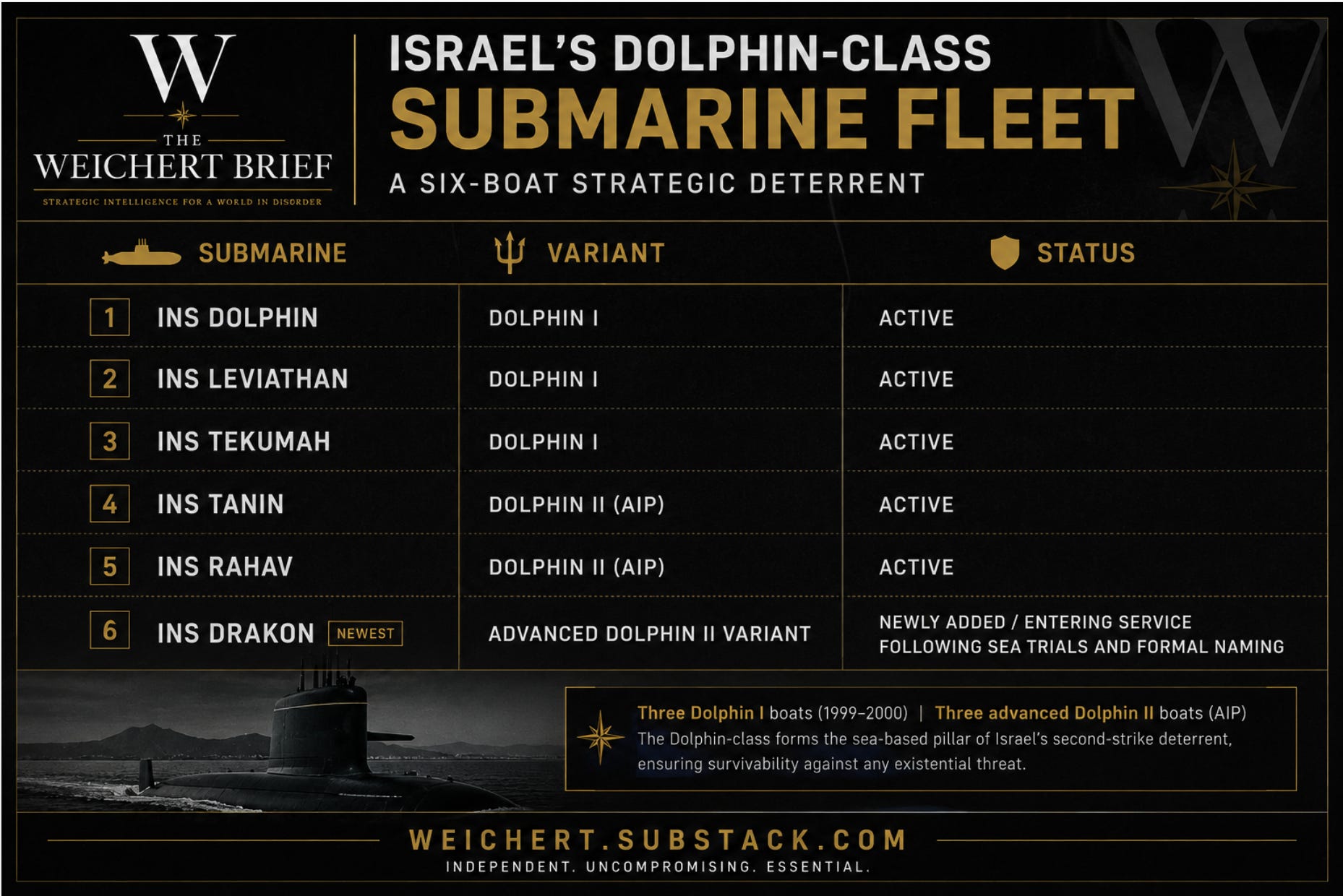
As of mid-2026, Israel has a total of six Dolphin-class submarines, although not all are necessarily at the same level of operational readiness. Germany’s Howaldtswerke-Deutsche Werft (HDW), part of Germany’s leading naval shipbuilder, ThyssenKrupp Marine Systems (TKMS), builds the Dolphin-class diesel-electric submarine.
Following the 1991 Gulf War, Tel Aviv concluded it required a survivable second-strike capability against regional adversaries.
Germany agreed to help finance the first three Dolphin-class submarines, partly as a political gesture acknowledging Germany’s historical responsibility toward Israel after the Holocaust.
Berlin also subsidized subsequent boats of this class, although Israel contributed a much larger share of the cost. What Israel got, therefore, was not your typical off-the-shelf German sub.
Between 1999 and 2000, Israel commissioned three Dolphin-class submarines from HDW. The fourth and fifth submarines were procured in 2006 and featured Germany’s world-class Air-Independent Propulsion (AIP) systems.
The INS Tanin was commissioned in 2014, and the INS Rahav was commissioned two years later in 2016.
The Dolphin-class is essentially a custom-built Israeli design based upon superior German engineering. While the hull and propulsion system derive from HDW’s expertise, Israel reportedly integrated much of the combat system, electronics, communications gear, sensors, and weapons to meet its own operational requirements.
Israel’s sixth submarine in its fleet is the INS Drakon, which features a noticeably enlarged sail. Most observers have speculated that it incorporates new launch systems or accommodates larger payloads.
While Israel has disclosed very little about the submarine, many observers believe it represents a significant evolution of the Dolphin II design rather than simply another copy.
The exact capabilities remain classified.
The Maritime Front Is Becoming Decisive
Thus far, the Iranians and their proxies have shied away from truly hitting Saudi Arabia.
As Saudi Arabia faces Iranian proxy pressure, the potential for regional instability increases, underscoring the importance of Israel’s maritime focus for regional security.
And if the Saudis really did buckle under the Houthi pressure, then the entire US military position in the region might implode—which is sending Israel into spasms. So, this weekend was a good time to publicize that they were moving a Dolphin-class submarine into the Red Sea.
Israel wants to deter the Houthis and their Iranian backers by signaling they are moving nuclear-capable assets closer to either Yemen or, eventually, near Iran.
Tel Aviv’s deployment of its Dolphin-class submarine into the Red Sea signals a strategic shift, emphasizing that Israel recognizes the importance of maritime geography over traditional airpower in ensuring regional security.
The Strait of Hormuz remains contested. The Bab el-Mandeb has become one of the world’s most important—albeit dangerous, thanks to its proximity to Houthi territory in Yemen. Commercial traffic throughout the Red Sea continues to face disruption from the Iranian-backed Houthis.
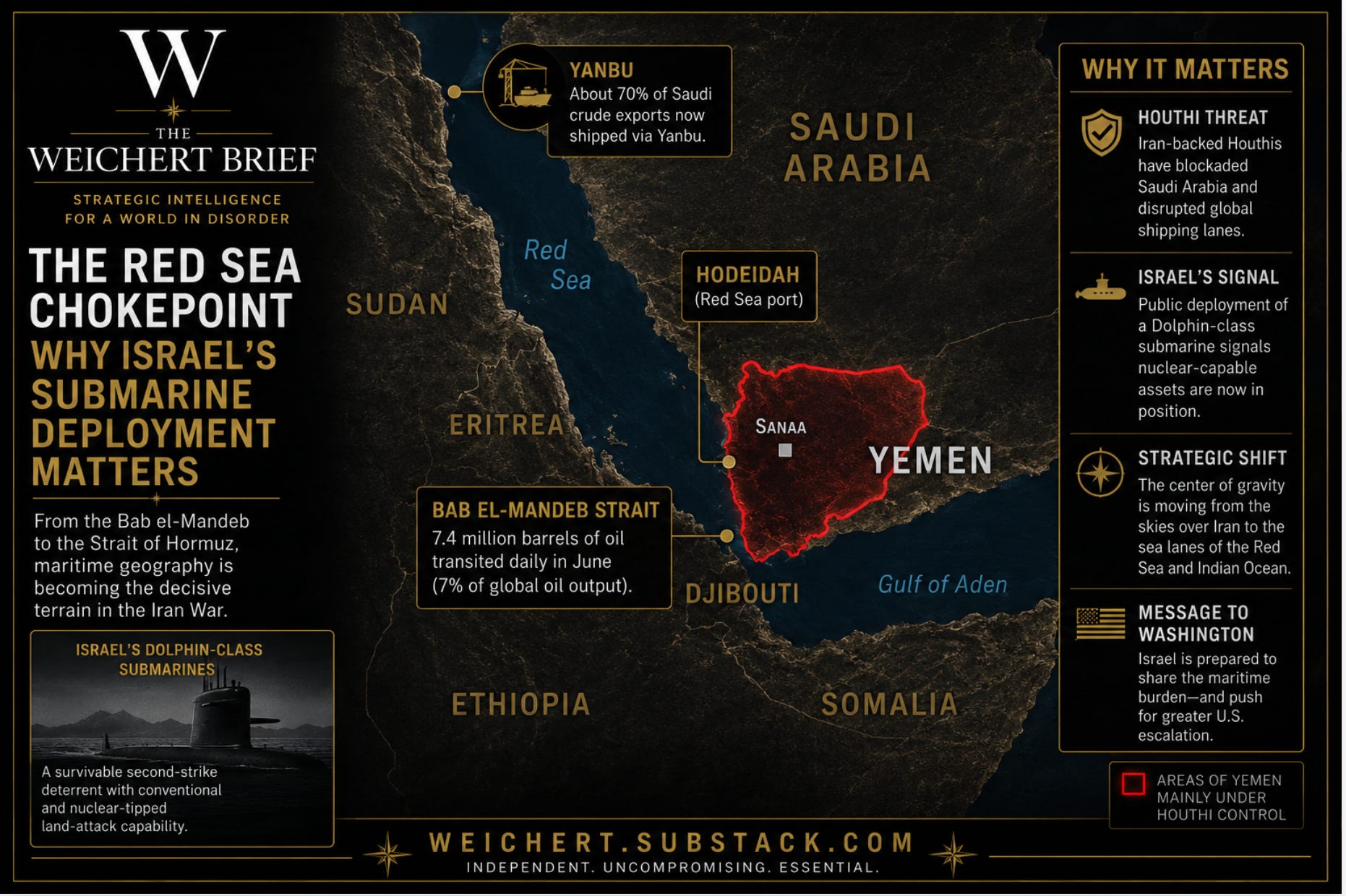
In other words, the strategic center of gravity is shifting away from the skies over Iran and toward the sea lanes connecting the Mediterranean, the Red Sea, and the Indian Ocean.
That shift fundamentally changes Israel’s military requirements. Airpower alone will not guarantee freedom of navigation. Fighter aircraft might destroy missile launchers, but they cannot remain over the Red Sea indefinitely.
And for all the talk about how the Houthi blockade of the Red Sea impacts the Saudis, the Israelis also depend upon the Red Sea for their southern ports. Over the years, the Houthis have blockaded Israeli access to the Red Sea.
Under current circumstances, though, the Israelis can ill afford to allow this condition to persist.
Plus, surface warships can escort merchant vessels.
Still, they’re expensive to operate, highly visible, and increasingly vulnerable to the kind of anti-ship ballistic missiles (ASBMs) that the Houthis possess in large quantities.
Besides, the Israeli Navy is small. It has to husband its maritime capabilities in ways that larger countries might not have to.
A submarine offers Israeli naval planners something different. It can remain hidden for extended periods, quietly collecting intelligence, monitoring Iranian logistics, tracking Houthi maritime activity, and positioning itself to strike high-value targets (if deterrence fails).
Its greatest contribution is not necessarily firing weapons. Israeli leaders likely hope that the presence of this submarine near Houthi or Iranian territory would force their adversaries to know that they can strike at any time.
A Message to Washington
There may also be a third audience that has received far less attention with this public deployment of one of Israel’s Dolphin-class submarines: the United States. Washington spent months attempting to protect commercial shipping through the Red Sea, all while managing a broader regional confrontation with Iran.
The strain on American naval forces has become increasingly apparent.
Israel’s highly visible submarine deployment demonstrates that Tel Aviv is prepared to assume a greater share of the maritime burden surrounding its own security.
It also signals that Israel has no real interest in de-escalating and is quietly goading Washington into taking more aggressive action under the pretense that the Israelis will have the backs of the Americans as escalation occurs.
By allowing the submarine to be seen departing Eilat, Israel reminded every actor in the region that one of its most survivable military assets was heading into the very water where the next phase of the conflict will likely unfold.
The Next Phase of the Iran War
Clearly, Israeli leaders increasingly believe that the decisive battles of the Iran War will not occur solely over Natanz, Tehran, or Southern Lebanon. They will also occur across the maritime corridors stretching from the Bab el-Mandeb to the Strait of Hormuz.
If that assessment is correct, then the public departure of a single Dolphin-class submarine may ultimately be remembered as one of the earliest indications that Israel had begun preparing for an entirely different kind of war.
A war that could signal the nuclear genie being let out of the proverbial bottle.
The corporate press tells you what happened yesterday.
The Weichert Brief tells you what happens next.
If you value independent geopolitical analysis that looks beyond the headlines, reader support keeps this publication alive—and growing.
$8/month
$80/year
$250 Founder’s Circle (includes the quarterly WEICHERT REPORT Forecast, exclusive intelligence briefings, and members-only expert videos).
Join today.
No slogans. No sacred cows. Just reality.
The world is changing faster than most people realize.
China is rising. The Middle East is exploding. Biotechnology is rewriting the rules of power. America’s strategic position is under unprecedented strain across the board.
I’ve spent years studying these trends and distilling them into four national bestselling books:
Winning Space: How America Remains a Superpower (2020) — Makes the case that America’s ability to remain the world’s leading power depends on its willingness to dominate the ultimate strategic high ground of space.
The Shadow War: Iran’s Quest for Supremacy (2022) — How Iran became the Middle East’s most disruptive power, and why its struggle with the US will determine the future of the region.
Biohacked: China’s Race to Control Life (2023) — How China is seeking to master the science of life itself, and why the nation that wins the biotechnology race may determine the future of global power in the twenty-first century.
A Disaster of Our Own Making: How the West Lost Ukraine (2024) — Tells the untold story of how decades of Western strategic errors turned Ukraine into the battleground for a war that was far from inevitable.
Weichert’s next book, “Fortress Americas: A New Monroe Doctrine,” will be released NOVEMBER 10, 2026!
If you enjoy The Weichert Brief, you’ll find the same analysis—just deeper and more comprehensive—in my books.
The future belongs to those who understand what’s coming.
I am hoping... and of the opinion, that IF Israel launches nukes at Iran... Israel will cease to exist...
Which would be a blessing on the entire world.
I believe some high official from CHINA may have said that... Russia might... Turkey, which likely has access to nukes, might... Pakistan had once threatened the same... but the Pakis are two-faced snakes.
Ironic that Israel started the war on the knowingly false claim -repeated endlessly by Netanyahu for decades- that Iran was "weeks" from obtaining a nuclear weapon (despite Tulsi Gabbard's repeated testimony under oath that all 18 US Intelligence agencies said Iran did NOT possess a nuclear weapon) Now, Israel threatens Iran with a nuke- after it invaded Iran, massacred civilians, and assassinated leaders- all on the American taxpayer dime (after stealing the nuclear technology from America). Israel needs to be decisively and publicly told it will cease to exist if it nukes 90 million Iranians- most of whom are innocents.