

The Five States That Will Shape a Post-American Middle East
By 2030, a new regional order will dominate the Middle East. Neither the United States nor Israel will sit at its center.

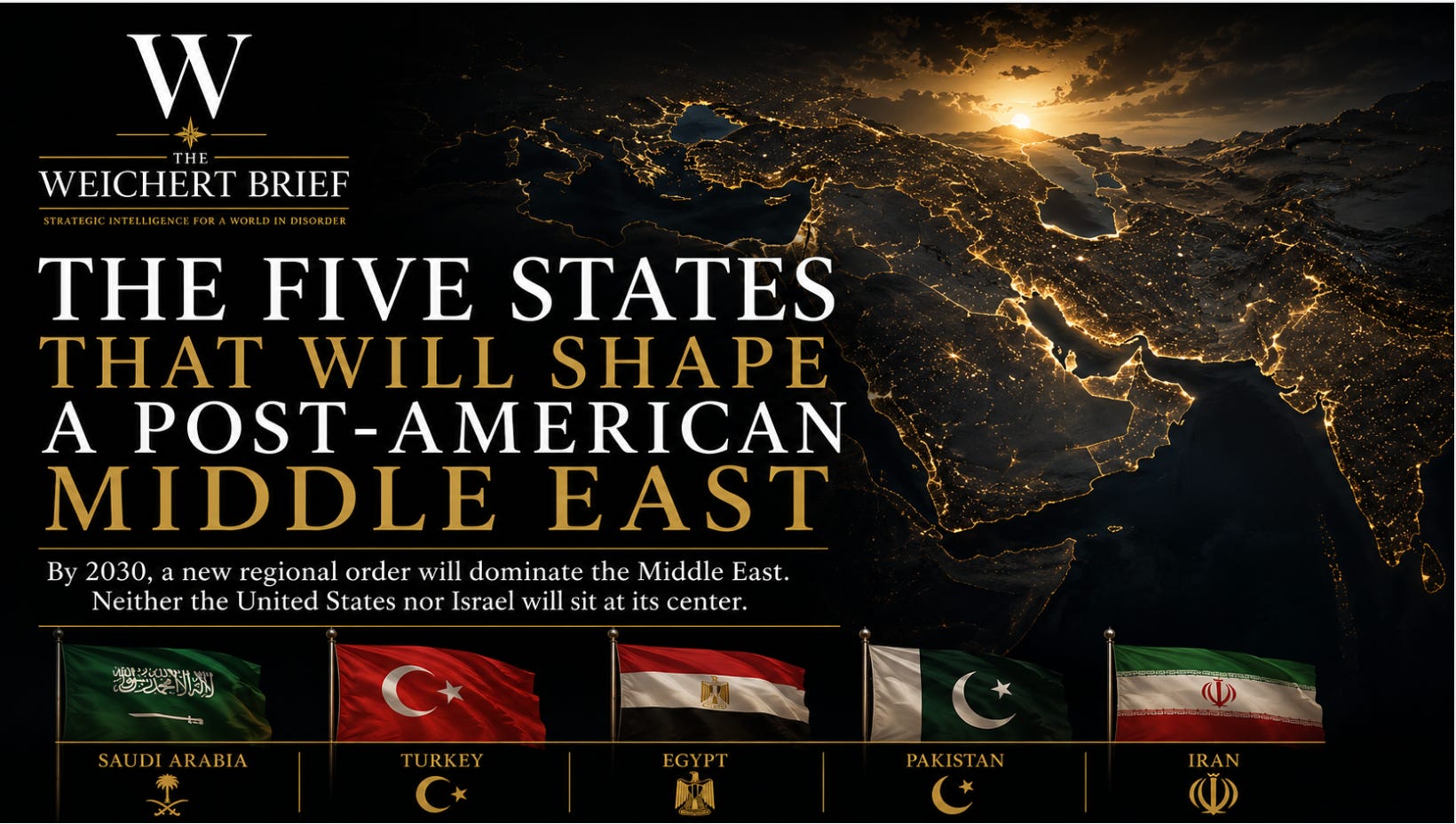
BLUF: The Iran War did not create an Iranian Middle East. Instead, it accelerated the collapse of the American-led regional order that has existed since the end of the Cold War. What emerges in its place will resemble a balance-of-power system dominated by regional actors. Iran, Turkey, Saudi Arabia, Egypt, and Pakistan are positioning themselves to shape the region’s future. The winners will be the states that adapt to this new reality. The losers will be those who continue acting as though Washington remains the sole arbiter of events.
For more than three decades, every major question in the Middle East ultimately revolved around the United States.
The Iran War exposed the limits of that system.
Washington remains the world’s strongest military power. Yet months of fighting failed to produce decisive political results. Iran survived. America’s regional allies began reassessing their assumptions. New centers of power emerged. Old alliances weakened.
The result is not an Iranian empire. Nor is it an Israeli hegemony. American primacy is disappearing, too.
What is emerging instead resembles the balance-of-power systems that once dominated nineteenth-century Europe, in which multiple regional actors compete while preventing any single state from becoming dominant.
The five states best positioned to shape that new order are Iran, Turkey, Saudi Arabia, Egypt, and Pakistan.
Together, they form what Dr. Arta Moeini has termed the “Middle East Five,” or simply, the “ME-5.” Here’s Dr. Moeini of the Institute for Peace & Diplomacy explaining his concept of a new Middle East balance of power:
Iran Won By Not Losing
For nearly half a century, the Islamic Republic of Iran has existed as the region’s primary outsider. Since the 1979 Islamic Revolution, successive coalitions of states have sought to contain, isolate, weaken, or overthrow the regime. Saddam Hussein attempted it during the Iran-Iraq War.
The Gulf Arab monarchies spent decades financing efforts to counter Tehran’s influence.
The United States built an entire regional security architecture around containing Iran. Israel increasingly came to view the Islamic Republic as its principal strategic threat.
In response, Iran built its own network of partners and proxies across the region. What Tehran called the “Axis of Resistance” allowed the Islamic Republic to project power despite sanctions, isolation, and repeated efforts to undermine it.
All those decades of shadowboxing culminated on February 28.
Washington and Tel Aviv believed they were launching a lightning war that would decapitate Iran’s leadership, shatter the regime’s command structure, and create the conditions for a domestic uprising against the Islamic Republic. Instead, the conflict evolved into a grinding war of attrition.
Nothing went according to plan.
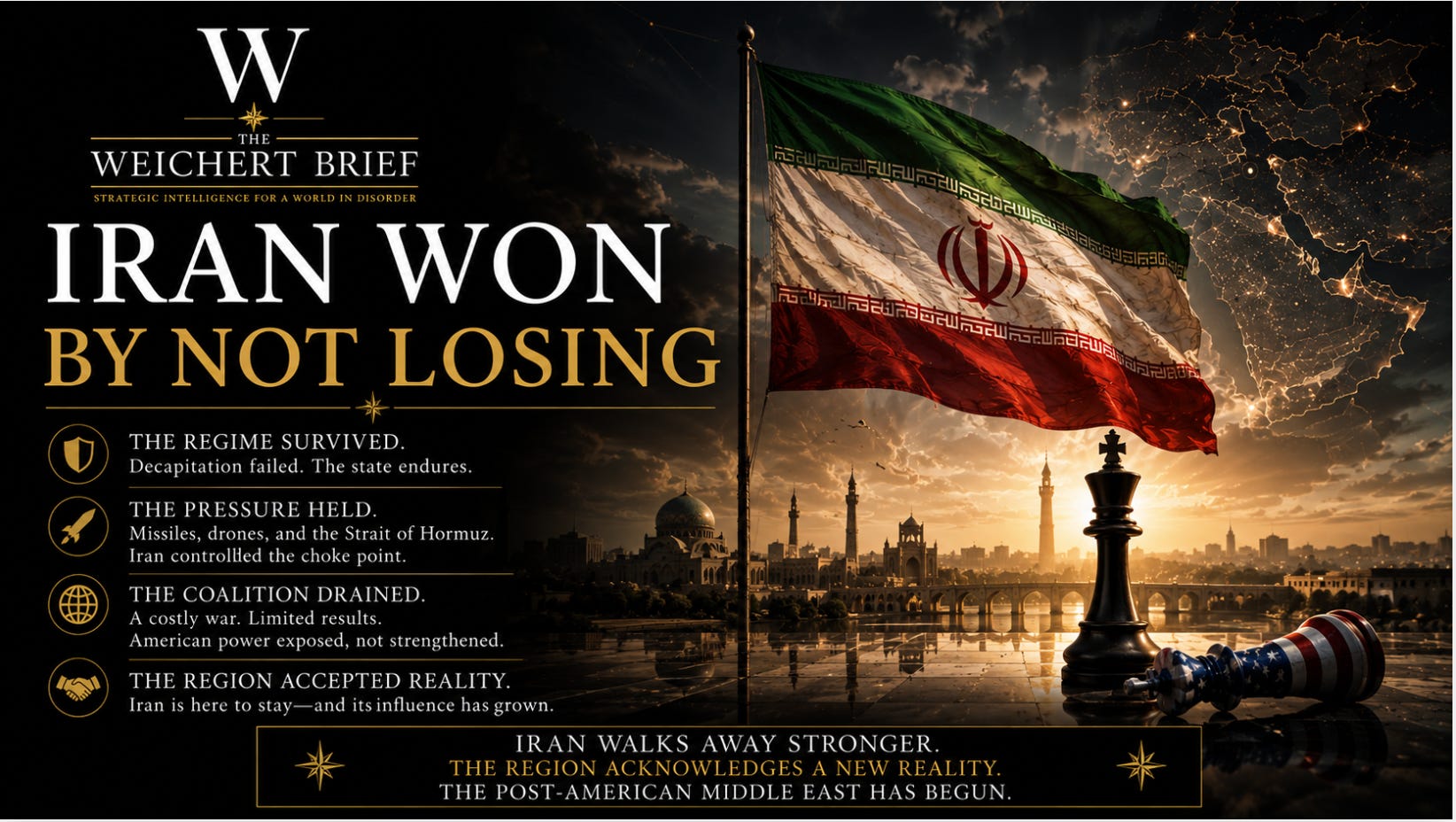
Rather than collapsing, Iran adapted. The regime survived the initial decapitation strikes. Its military remained operational. Its missile and drone forces continued functioning. Most importantly, Tehran retained the ability to impose costs on both the United States and Israel.
The clearest example of this came in the Strait of Hormuz. By exercising de facto control over one of the world’s most important maritime chokepoints, Iran demonstrated its ability to disrupt the global economy in ways that few analysts believed possible before the war. American efforts to offset that pressure proved costly and only highlighted how unprepared Washington was for a prolonged conflict.
The political consequences may prove even more important than the military ones.
Iran’s younger leadership inherited a regime under attack from the world’s most powerful military coalition. Instead of presiding over its collapse, they watched it endure. At the same time, many of the optimistic assessments coming from Washington—that Iran’s missile forces had been disabled, its drone infrastructure destroyed, and its military effectively neutralized—have been quietly revised as the war dragged on.
The result is a profound shift in perception.
For decades, Iran’s adversaries treated the Islamic Republic as a problem that could eventually be solved. The Iran War has forced a different conclusion. Tehran may be weakened. It may be battered. But it is not going away. In fact, it is already stronger at the strategic level for having survived the full conventional force of both the US and Israeli war machines.
That realization changes the strategic landscape.
The lesson Iran’s leadership has drawn from this conflict is simple: the regime can absorb extraordinary punishment without collapsing. The lesson many of its neighbors are drawing is equally significant. If Iran could survive confrontation with the United States and Israel, then it must be treated as a permanent feature of the regional order rather than a temporary obstacle to it.
This is where the post-American Middle East begins to emerge.
Here’s former French Prime Minister Dominique de Villepin explaining to CNN’s Christiane Amanpour how US-Israeli military actions against the Islamic Republic of Iran have resulted in the equivalent of a “Geopolitical Chernobyl” in the Middle East:
The longer the war continues, whether as an active conflict or a frozen one, the more it drains American resources and political capital while reinforcing Iran’s status as a durable regional power. The greatest strategic victory Tehran may achieve is not military at all. It is convincing the rest of the region that it cannot be ignored, isolated, or removed.
